01 Ingest
Reads Arabic and English documents.
RSEEN Core reads digital text and scans in Arabic and English through native extraction, OCR and Saudi-hosted providers.
Saudi hosting and inference
RSEEN builds the credit file from Arabic and English documents: every figure traced to its source, every table computed by a stated formula, every conflict between sources visible before the decision. The decision is the institution's.
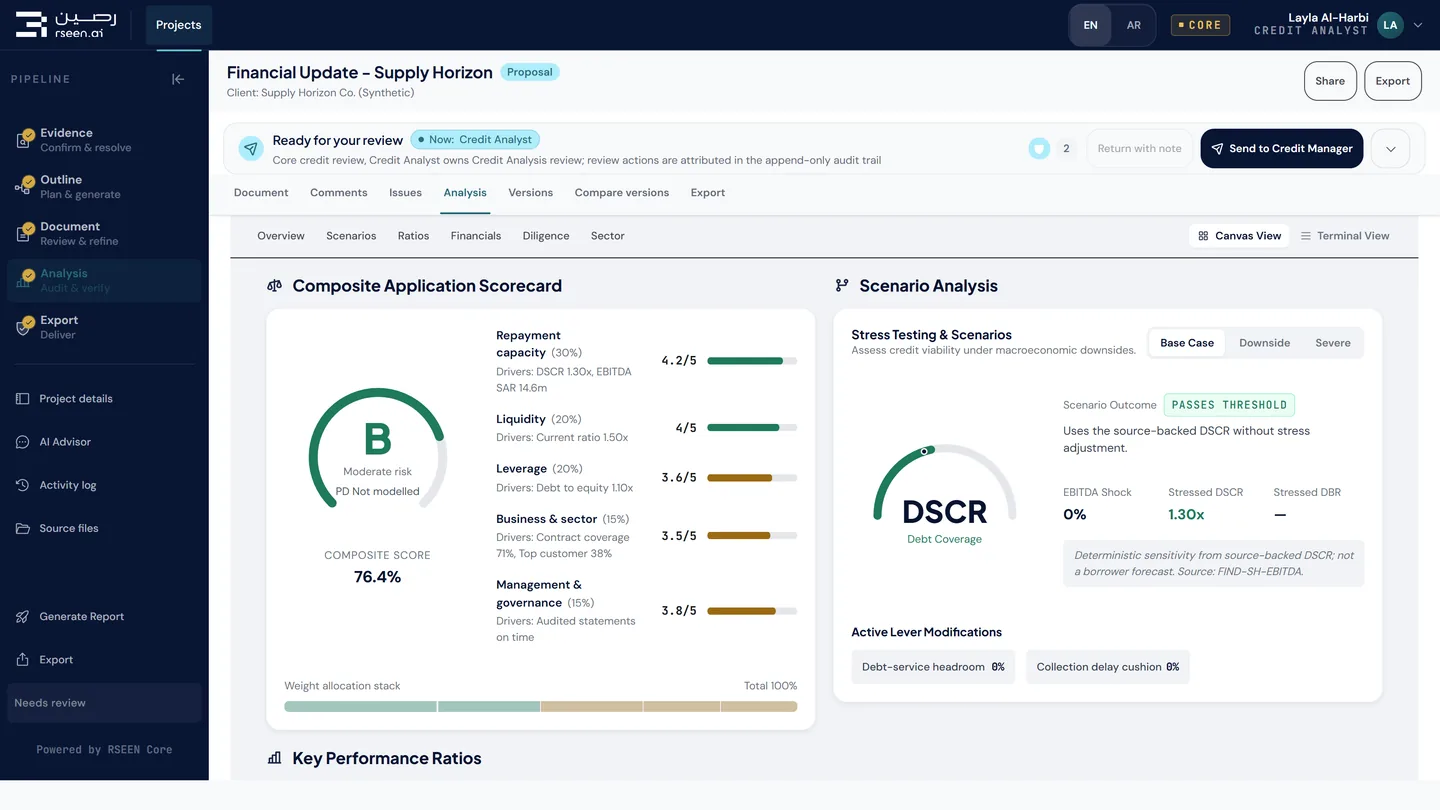 RSEEN Core interface · synthetic case
 RSEEN Core · the entry product
RSEEN Core reads digital text and scans in Arabic and English through native extraction, OCR and Saudi-hosted providers.
Credit ratios and tables are computed from approved inputs using defined formulas. If evidence is insufficient, the scorecard withholds the grade instead of guessing.
Conflicting values and citations stay visible for the analyst instead of being silently averaged or chosen.
Role-based workflows route each review to its owner. Handoffs are attributable, and a changed file can reopen the review.
RSEEN Core interface · synthetic case
Start with RSEEN Core as a complete sidecar product. Configure the institution's Playbook within RSEEN. Add modules as the institution's scope earns them.
A complete client-facing product for document intake, source-linked evidence, formula-computed analysis, visible conflict, evidence sufficiency and attributable human review.
The Credit Control Blueprint produces the client-kept Playbook Specification and configures the Initial RSEEN Core Configuration Baseline.
The borrower document room and connectors are RSEEN Core modules. First named module: Equipment Financing. Origination workflow modules are planned and scoped with each institution.
See the modulesKeep the systems and authority you trust. Add RSEEN Core beside them. One platform throughout.
Shared-responsibility boundary
Data never leaves Saudi Arabia. Keys stay with the institution. The map shows where each layer runs and who owns the decision.
Institution boundary
Decision and operating authority Identity, authority, keys, data policy and the credit decisionRSEEN platform boundary
Optional providers and connectors
Documented routes Inference, OCR, messaging, signing and client systemsRSEEN keeps an append-only, attributable audit trail of the supported credit workflow—who did what, when, and against which evidence. It is written for its readers: internal audit, the credit risk committee, and the SAMA supervisory examiner following one figure from source to decision.
The map keeps responsibility clear from evidence and computation through workflow and credit decision.
Built for the people who carry the decision
01 · Policy rules and calculations
Financial spreading, ratios and policy tests computed from source-linked inputs under the rules of the institution itself.
See RSEEN Core02 · Override audits and explainability
Every override and review action is attributable in an append-only trail, and each result can explain the evidence behind it.
Inspect the method03 · Saudi residency, tenant isolation, keys
Data never leaves Saudi Arabia. Keys stay with the institution. RSEEN runs single-tenant or on-premises, with application and inference data in-Kingdom.
Review the boundaryFrom fit to activation
Assess the fit, inspect one authorised file, map the controls, measure the pilot, then activate the scope that earns its place.
Identify the credit workflow where evidence controls can create the most value.
Inspect one authorised representative file after file authority and the handling boundary are agreed.
A paid, fixed-scope engagement, typically four to eight weeks when the institution's working team, access and environment are in place, that produces the client-kept Playbook Specification, a working, versioned Initial RSEEN Core Configuration Baseline and a Scope Gap Register.
Test the agreed workflow on a defined case set and clear success measures.
Activate RSEEN Core, standalone or connected to the systems you run. Further modules follow the measured case.
Diligence questions
Can every material figure open its source document and page?
LIVE Yes: material facts carry the document, page and snippet they came from.
Which formula produced this table, and which version of it?
LIVE Defined tables are computed by formula; the applied formula version stays inspectable.
What happens when two sources disagree?
LIVE Both values stay visible with their sources until an authorised reviewer records a disposition.
What happens when the evidence is thin?
LIVE Under the configured evidence rule the scorecard can withhold the overall grade, and the missing input is shown.
Who overrode what, and why?
LIVE Every override and review action is attributable in an append-only trail, with the reason recorded.
Where does the data run and rest?
LIVE Data never leaves Saudi Arabia.
Who holds the keys?
LIVE The institution, through its own key-management system or HSM.
Does it read Arabic documents, or only show an Arabic interface?
LIVE Both, and they are separate claims: Arabic and English documents are read through native extraction and OCR; extraction accuracy is measured on the institution's own corpus.
Where RSEEN stands today: a limited paid implementation with a SAMA-licensed financing company; a second SAMA-licensed financing company in scoping under NDA; and a CMA-regulated investment firm in pre-pilot scoping.
Your Playbook rules, formulas and the agreed evidence-sufficiency condition configured and proven in a real RSEEN Core workspace.
Named credit, IT and security counterparts on both sides, with an agreed decision owner.
We map your file types, sources and review path against the configured baseline.
Each review round records what changed, who decided, and what it means for scope.
Qualitative acceptance criteria fixed before the work starts — no targets attached after the fact.
GulfBoost is the parent company behind RSEEN — a Saudi enterprise technology firm operating in-Kingdom since 2014. RSEEN is its flagship product.